Does a carbon monoxide detector detect gas leaks? No, do not count on it. A CO alarm is built to sense carbon monoxide, not natural gas. PG&E publishes separate guidance for each, and it describes a natural gas (methane) detector as a different device from a smoke or CO alarm.
If you are in Marina, CA and you smell gas right now, stop reading. Leave the building, call 911 from a safe distance, then call PG&E at 1-800-743-5000. The rest of this page explains the difference between the devices and what a plumber checks once the area is safe.
Two gases, two different problems
Carbon monoxide and natural gas are not the same gas, and they do not come from the same failure. Natural gas is the fuel. It leaks from a pipe, a fitting, a valve or an appliance connection. Carbon monoxide is a byproduct. It forms when fuel burns without enough air, or when exhaust cannot leave the house.
PG&E describes carbon monoxide as a dangerous gas you cannot smell or see. Its sources include poorly vented water heaters and blocked vents. Natural gas has a sulfur, rotten-egg odor added so people notice it, and PG&E lists hissing, whistling and dead vegetation as other signs of a leak.
That is why one alarm cannot do both jobs. A CO alarm tells you exhaust is building up. It does not tell you a gas line is leaking into a closet.
What each device actually detects
| Device | Built to sense | Does not replace |
|---|---|---|
| Carbon monoxide alarm | Carbon monoxide from burning fuel | A natural gas detector. PG&E says buy a UL-approved CO detector |
| Natural gas (methane) detector | Natural gas | Smoke or CO alarms. PG&E says it does not detect smoke, fire, heat, CO or other gases |
| Smoke alarm | Smoke and fire | CO or gas detectors |
| Combination gas and CO unit | Both, if it works | Careful shopping. Federal regulators have warned about some models |
PG&E's page on methane detectors states that smoke and CO alarms are still required. It also says PG&E is not notified automatically when a detector sounds, so a detector is not a substitute for calling.
Be careful with combination units
In August 2026 the U.S. Consumer Product Safety Commission warned owners to stop using a model of plug-in natural gas and carbon monoxide detector that can fail to alert to CO, citing 91 reports of failure. A 2024 recall also covered a combination alarm that could fail to detect.
The commission's advice is to buy CO detectors that meet UL 2034.
If you smell gas: the order of operations
Leave now
Walk out with the people and pets who are with you. Do not stop to open windows or collect things.
Avoid sparks
Do not use matches, lighters, flashlights, light switches or a garage door opener on the way out.
Call 911 from a safe distance
PG&E's own guidance puts 911 first.
Call PG&E at 1-800-743-5000
If you turned the gas off at the meter, PG&E says you must call them to restore it.
Call a plumber only after it is cleared
A plumber can find and repair the leak once the utility says it is safe.
Do not call 811 for a gas smell. PG&E does not list it in its gas leak steps. We also cannot promise a response time for gas calls, because 911 and the utility come first.
Your gas provider may differ by address. Check your bill for the emergency number if you are not a PG&E customer.
Where a plumber fits in
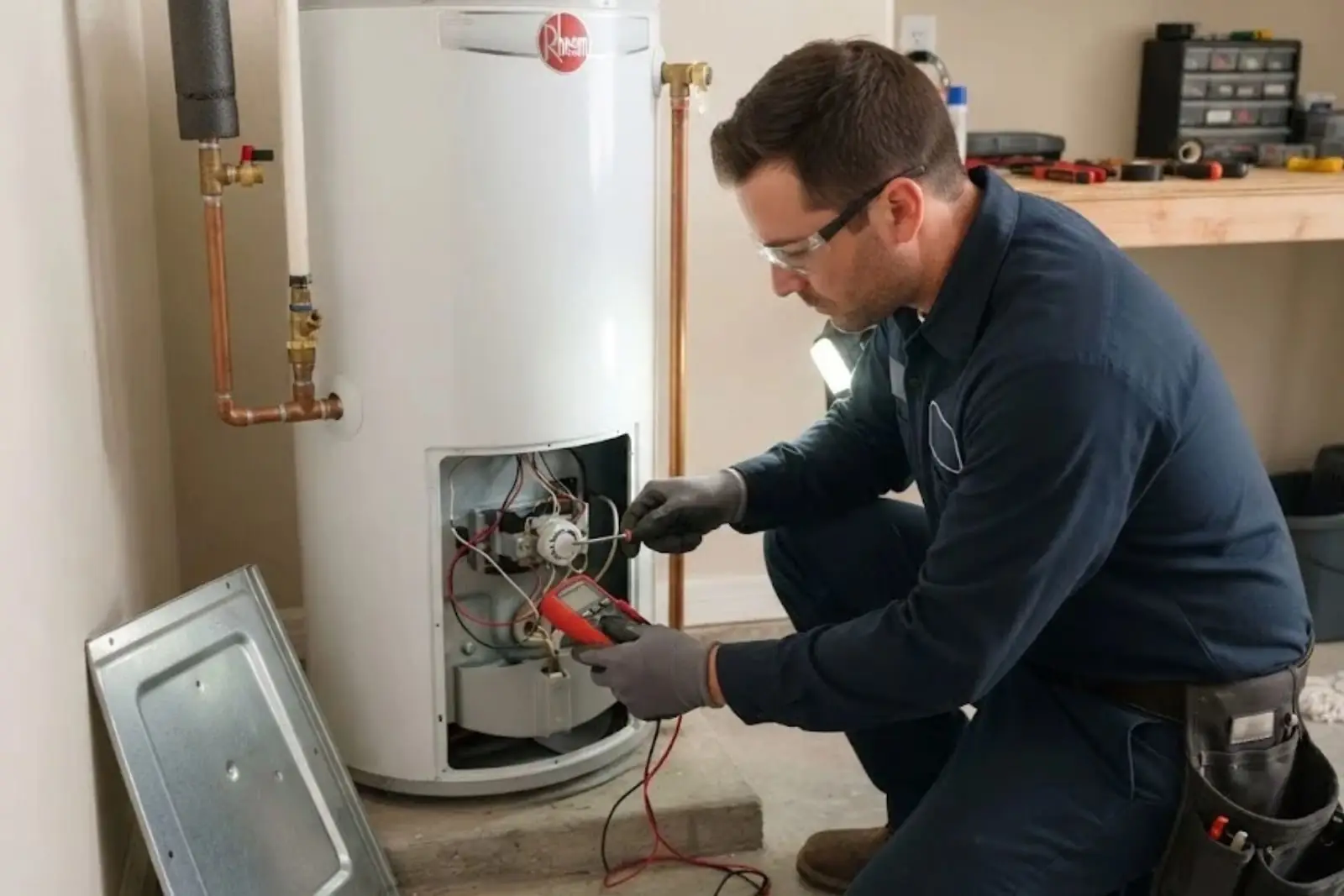
Plumbers deal with gas-side parts on water heaters, ranges and dryers, and with the venting on a gas water heater. Typical checks include the gas shutoff valve, the flexible connector, the fittings at the heater and the flue path.
The usual test is simple. After gas-side work, connections are brushed with soapy water. Bubbles mean gas is escaping, and the right response is to shut off the gas and call for help. A home guide for water heater thermocouples gives the same advice.
- A flue that is loose, rusted through or sloping the wrong way.
- Soot marks around the draft hood or the heater's front.
- A pilot flame that is yellow or flickers.
- A new smell right after an appliance was moved or replaced.
- A CO alarm sounding near a gas appliance.
If any of those show up, have the appliance checked before you keep using it. Our pages on water heater repair and water heater installation cover that work.
Where to put the detectors you buy
For a methane detector, PG&E says to place it 3 to 10 feet from gas appliances and within 12 inches of the ceiling. Follow the manufacturer's guide for the model you buy.
For CO, PG&E says to install a UL-approved detector and adds a warning. Preventing a CO problem is better than relying on the alarm. That means a properly vented heater, a clear flue and regular checks.
- Test every alarm on the schedule in the manual.
- Replace units at the age the manufacturer sets.
- Do not unplug a detector because it chirps. Find out why.
- Never treat a quiet detector as proof that the house is safe.
If the CO alarm sounds
The standard advice is to get everyone outside into fresh air and call 911. That is general safety advice and not a statement from the sources used here. Do not go back in to find the cause. Let the fire department clear the house, then have the appliance inspected.
A water heater or furnace that caused a CO alarm should stay off until a licensed professional has checked the venting and combustion.
What this means for Marina households
Census QuickFacts for Marina show an owner-occupied housing rate of 42.9 percent, which means a majority of households rent. Tenants cannot always see or service the water heater in a shared closet or utility room. If you rent, you still make the 911 and PG&E calls yourself, and then tell the owner or manager so the appliance is not used again until it is checked.
Marina is on the Central Coast, which is earthquake country. State law requires water heaters to be braced, anchored or strapped against earthquake motion. A heater that can shift can stress its gas connector, so ask for strap checks when anyone services it.
If a water heater is replaced, the City of Marina Building Division at (831) 884-1241 can tell you whether a permit is needed, since we could not confirm that on the city's public pages. For non-emergency police matters, Marina Police list 831-384-7575, and gas smells still go to 911.
We take calls from Marina and the surrounding area, including Seaside and Castroville.
Frequently asked questions
Do not count on it. A CO alarm is built to sense carbon monoxide. PG&E treats natural gas detection as a separate device with its own placement rules.
No. PG&E says a methane detector does not detect smoke, fire, heat or carbon monoxide, and that smoke and CO alarms are still required.
Leave the area right away, call 911 from a safe distance, and then call PG&E at 1-800-743-5000. Avoid anything that could spark.
No. PG&E's gas leak guidance does not list 811. Use 911 and the utility's emergency number.
Some are fine and some have failed. Federal regulators warned about one plug-in model in August 2026 and a combination unit was recalled in 2024. Check for UL 2034 listing on the CO function and check recall notices.
Yes, after the utility clears the area. A licensed plumber can locate and repair leaks at appliance connections and gas-side parts. Call (855) 575-2890 for a clear price before work starts.
PG&E lists poorly vented water heaters and blocked vents as sources of carbon monoxide. A plumber can inspect the flue and combustion.
Call 911 and PG&E first, no matter whose appliance it is. Then tell your landlord or property manager. Do not wait for permission to leave or to call.