A failed sewer line shows up as backups, soggy ground or a smell you cannot trace. Emergency sewer line repair in Marina, CA starts with our 24/7 line at (855) 575-2890, so a collapse found on a Saturday night still gets a response plan. We find the break on camera, explain it and quote the fix.
While you wait, stop using water. Every drop that goes down the drain has nowhere to go if the line is broken. Keep people and pets away from any wet or sunken patch in the yard.
Not every sewer problem needs digging. Some lines need a cleaning, some need a small spot repair and a few need lining or replacement. We explain which one you are looking at, with a clear price before work starts.
Sewage in the house or yard: first steps
- Stop all water use, including laundry and dishwashers.
- Do not flush. A broken line cannot carry it away.
- Keep children and pets out of the area and avoid touching wastewater.
- Open a window if there is a sewer smell, and leave the space if it is strong or you feel dizzy.
- Call (855) 575-2890. If sewage is spilling outdoors, also call the district at (831) 384-6131 or (831) 883-5900.
Same-day appointments are offered when available. Tell us what you see so we can plan the right equipment before we leave.
Who owns the sewer line? Marina Coast Water District code
According to Marina Coast Water District code, section 5.16.090, side sewers are maintained by the owner of the property they serve. The side sewer is the pipe from your house to the district's main. In plain terms, a broken lateral on your lot is normally your repair, not the district's.
The district owns and operates the pipes and pumps that carry wastewater onward to the Monterey One Water treatment plant. It also asks owners to inspect their laterals and keep them clear of trash and grease. District code on cleanouts calls for them at connections, at bends of 45 degrees or more and at the lateral connection, with spacing no greater than 100 feet. A cleanout near the problem makes diagnosis easier and cheaper.
If you rent, report the problem to your landlord or property manager right away. Marina has more renters than owners, and the owner of record is the one who decides on a repair.
Signs the line is damaged
| Symptom | Possible cause | Next step |
|---|---|---|
| Repeated main line backups | Roots, belly or broken joint | Camera inspection |
| Wet or sunken ground over the line | Leak or collapse | Urgent camera and locate |
| Gurgling in several drains | Partial blockage or offset pipe | Cleaning, then camera |
| Sewer smell outside | Cracked pipe or open joint | Camera inspection |
| Slow drains return after cleaning | Pipe damage that traps debris | Camera, then repair quote |
A camera is the dividing line between guessing and knowing. See sewer inspection for how that visit works, or sewer line cleaning if the line only needs to be cleared.
Spot repair, lining or full replacement
The right fix depends on how much of the pipe is damaged and what sits above it. Here is how the main options compare.
| Method | Best when | Trade-off | Typical cost |
|---|---|---|---|
| Spot repair | One short break or bad joint | Rest of old pipe stays | $600 to $1,050 per repair |
| Trenchless lining | Pipe is cracked but still in line | Needs a mostly open pipe | $90 to $250 per foot |
| Pipe bursting | Pipe is failing along its length | Needs entry and exit pits | $60 to $200 per foot |
| Open trench replacement | Collapse or heavy offset | Digging and yard restoration | $50 to $200 per foot |
These are published cost-guide figures from HomeAdvisor, Angi and This Old House for 2024 through 2026, and they are national. HomeAdvisor's 2025 guide puts a typical full replacement at $1,388 to $5,323. Most guides give no Central Coast numbers, so treat them as a rough scale, not a quote.
Trenchless lining and replacement, explained
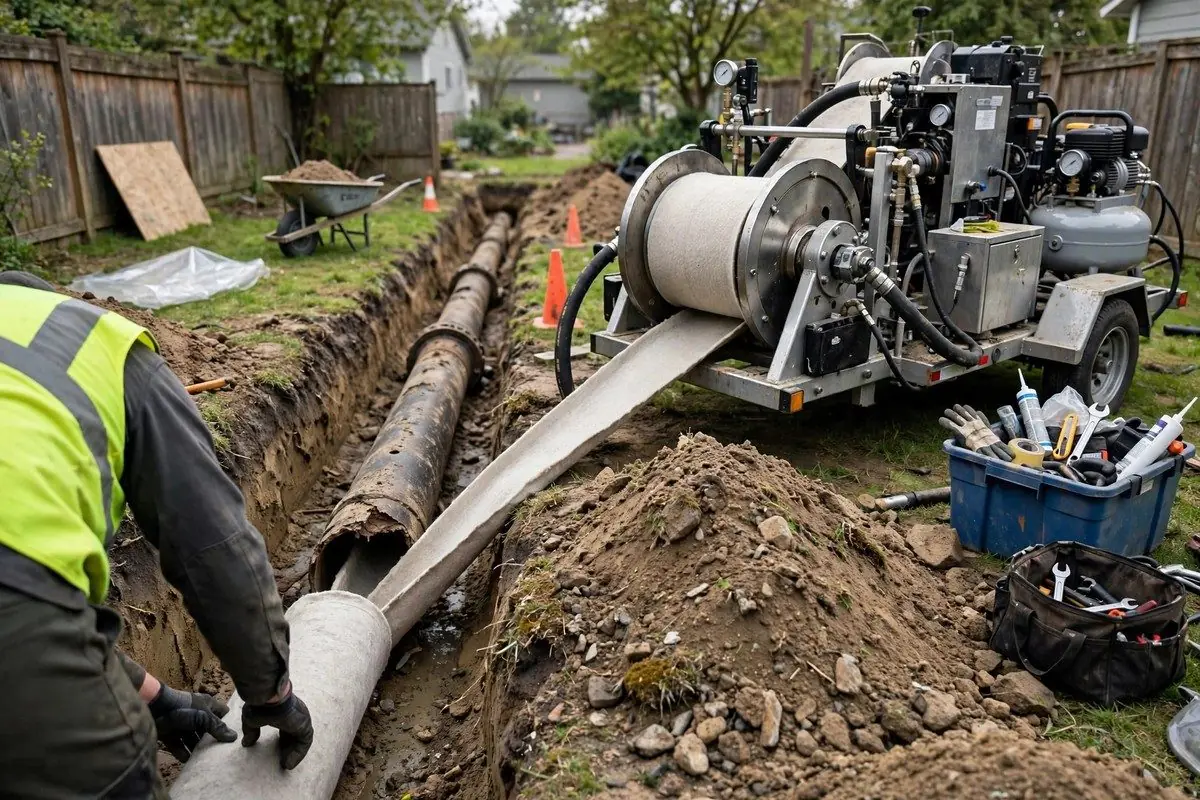
Trenchless work avoids a long trench. For lining, a resin-soaked tube is pulled into the old pipe and cured in place, creating a new pipe inside the old one. For pipe bursting, a tool pulls a new pipe through while breaking the old one outward.
Both methods need the line to be cleaned and surveyed first. A lining will not fix a collapsed section or a deep offset, and a pipe that is crushed flat may need a short dig. We tell you which parts of your run suit trenchless and which do not.
Marina sits on loose, unconsolidated dune sand. In ground like that, a pipe joint can drift open over time, and a continuous liner can be a good answer to open joints. Sandy ground also makes deep trenches wider than they look, so ask how the trench will be shored. Ask about permits too. The City of Marina Building Division at (831) 884-1241 handles building permits for the city.
Cast iron pipe repair
Older homes sometimes have cast iron drain and sewer pipe. It lasts a long time, but it corrodes from the inside, forming rough scale that catches debris and eventually thins the wall. Cracks and holes then let wastewater and roots in.
- A camera shows scale, pitting and cracks before any cutting begins.
- A short bad section can often be cut out and replaced with plastic pipe.
- A long corroded run may suit lining, if the pipe is still round.
- Heavy corrosion is a poor candidate for hydro jetting, so we do not jet it blindly. See hydro jetting for the safety trade-offs.
If cast iron runs under a slab, lining can avoid breaking concrete, but not every case fits. We say so plainly.
Keeping the sewer line healthy
Flush only human waste and toilet paper, as the district asks. Wipes labeled flushable do not break down. Keep grease out of the sink, since hot water and soap only move it down the line. If you plan to plant trees, keep them well away from the lateral, and have the line scoped if backups start. Our drain cleaning page covers smaller clogs that do not involve the main line.
Frequently asked questions
Yes. Call (855) 575-2890 any hour, any day. We prioritize active backups and collapses, and same-day appointments are offered when available. Tell us what you see so we can bring the right equipment.
Under Marina Coast Water District code 5.16.090, the owner maintains the side sewer that serves the property. The district handles its own mains and pumps. If you are unsure where your line ends, a camera and a call to the district help clarify it.
A camera answers it. If the pipe is intact and the problem is grease or roots, cleaning may be enough. If there are cracks, offsets or collapse, cleaning only buys time.
Often, yes. Lining and pipe bursting limit digging to small access pits. A collapsed or badly offset pipe may still need a trench for that section.
Sometimes. Lining can avoid breaking the slab if the pipe is still open enough. A camera survey tells us whether your run qualifies.
Published national guides show spot repairs of roughly $600 to $1,050 and full replacements of roughly $1,388 to $5,323 as typical ranges. Your price depends on length, depth, access and surface restoration. We give a clear price before work starts.
Yes. California requires a licensed contractor for most work over $1,000, and the district asks plumbers working under its code to be state licensed with insurance on file. Ask any contractor for a license number and check it with the Contractors State License Board.