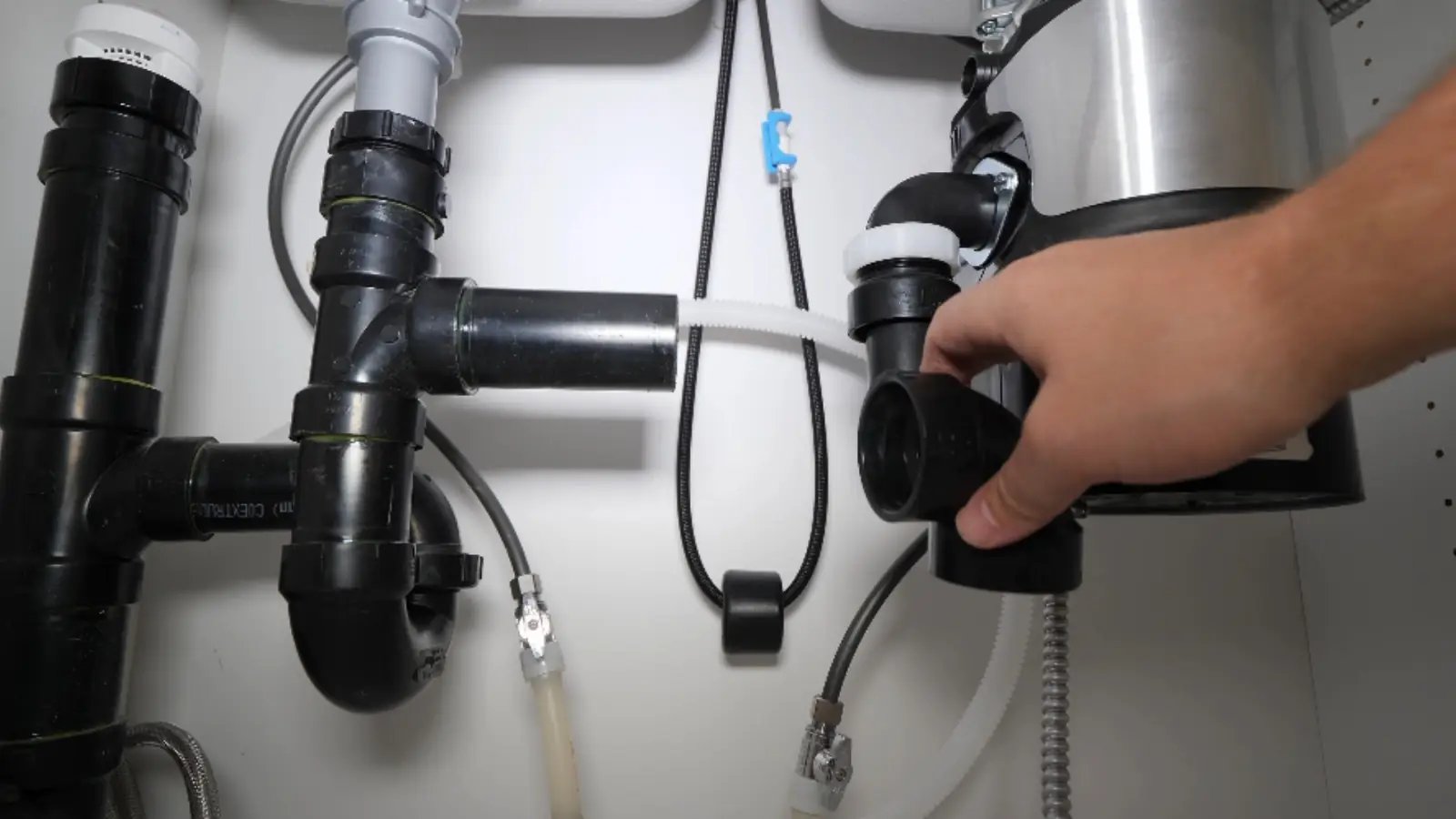
Kitchen sink garbage disposal installation is about a one-hour job when you are replacing a unit that already has power and a drain. It becomes bigger when you are adding the first disposal, because the sink needs a new flange, a reworked trap and often a switched outlet. A published 2025 guide, updated in 2026, shows replacement at $200 to $625 nationally, with an average near $550.
That is a national figure, not a Marina quote. This guide for Marina, CA homeowners covers when DIY makes sense, how the wiring works, the dishwasher knockout that trips up many first-timers, and what a plumber handles. If you would rather hand it off, call (855) 575-2890.
Replacing versus adding a disposal
| Situation | What is involved | Who usually does it |
|---|---|---|
| Swap an existing unit of the same size | Remove the old mount, attach the new disposal, reconnect the drain and power | Handy homeowner or plumber |
| Add a disposal where there is none | New sink flange, new trap and tailpiece, dishwasher tie-in, new power | Plumber, plus an electrician if wiring is needed |
| Move to a different brand or size | Mount and discharge may not line up | Plumber |
| Sink with two bowls | Drain from the second bowl must tie into the disposal outlet | Plumber |
The deciding factor is what is already under the sink. Existing power, an existing drain and a matching mount keep the job short. Anything new adds trades, parts and time.
What a published guide shows for cost
According to HomeAdvisor's garbage disposal replacement guide, titled 2025 and updated in June 2026, the cost runs $200 to $625 with an average near $550. It lists labor at $50 to $100 per hour for about one hour. That range is national, and we found no Central Coast figure.
Prices rise with feed type, horsepower and material. A continuous-feed unit is the common choice, while a batch-feed unit costs more. Bigger motors cost more and grind tougher scraps. A new grounded outlet or plumbing changes add to the total, so ask what is included.
Reading a quote
A price that covers only the unit is not an installed price. Ask whether haul-away of the old disposal, a new power cord or hardwire kit, and any trap parts are included. We give a clear price before work starts.
Wiring: cord, hardwire and the switch
Most disposals need their own power. Some units come without a cord, and the installer adds a cord to plug into an outlet under the sink. Others are hardwired into a junction box. Which one your kitchen uses depends on how the last unit was wired and what your electrical code allows.
- Confirm the breaker is off and test the wires with a tester before touching them.
- Check that the cord or cable is sized for the unit and the strain relief is tight.
- Make sure the outlet is grounded and, where required, protected by a GFCI. Your electrician or plumber can tell you which applies.
- Use a wall switch placed where you can reach it without leaning over the sink.
- If there is no power under the sink, stop. New circuits and outlets belong to a licensed electrician.
Plumbers handle the water side. For a new line to the switch or a new circuit, ask your plumber who coordinates the electrical part so the work is inspected as one project.
The dishwasher knockout
Many disposals have a small plug on the side, called the dishwasher knockout. If a dishwasher drains through the disposal, that plug must be punched out before the dishwasher hose is connected. If it is left in, the dishwasher cannot drain, and water stands in the bottom of the machine.
The fix is simple if you catch it. Remove the plug with a screwdriver and light hammer tap, then fish the loose piece out of the disposal chamber with pliers. If you drop it in and forget it, it will jam the grinder. Some homes use an air gap or a high loop instead, so check what the dishwasher needs.
DIY or plumber: a plain decision list
DIY is realistic when
- You are replacing a unit with a similar mount and discharge.
- Power already runs under the sink and is grounded.
- You have a basin wrench, plumber's putty and a flat surface to work on.
- Nothing is leaking or corroded at the sink flange.
Call a plumber when
- There was never a disposal here.
- The drain is slow, corroded, or leaks when you loosen it.
- The dishwasher, second bowl or filter tap has to be rerouted.
- The old mount is stuck and the sink may crack.
A leaking disposal that you cannot stop is a case for garbage disposal repair rather than a fresh install. A new sink drain layout falls under plumbing installation.
Common mistakes
- Skipping the knockout, then wondering why the dishwasher stays full.
- Over-tightening the mount ring, which cracks the sink or seats the gasket unevenly.
- Forgetting plumber's putty under the flange, which causes a slow drip.
- Setting the discharge elbow at the wrong angle so the trap slopes back toward the sink.
- Running the disposal before checking for leaks with water running for a few minutes.
Marina notes: what the sewer system can take
Marina Coast Water District owns and operates the pipes and pumps that carry wastewater to the regional treatment plant, and the owner maintains the side sewer from the house to the district main under district code. A disposal sends more solids down that line. For you, that makes grease and scraps a maintenance matter on your own pipe, not just the street's.
The district's guidance for homes is clear: never pour fats, oils or grease down a sink or garbage disposal. It also notes that hot water and soap do not eliminate FOG, because it can reform and solidify in pipes. So running the disposal with hot water does not make a greasy pan safe to pour. Scrape fat into the trash instead.
The district also asks residents to flush only human waste and toilet paper. If several drains back up at once, MCWD lists (831) 384-6131 and (831) 883-5900 for reporting a sewer backup or spill. A disposal that keeps jamming or a sink that backs up with the dishwasher can point to a line problem, so see our drain cleaning page.
We also serve Seaside and Castroville. For permit questions on added wiring in Marina, the Building Division is at 209 Cypress Avenue, (831) 884-1241.
Frequently asked questions
A like-for-like swap often takes about an hour, which matches the labor time in published guides. Adding a first disposal takes longer because of plumbing changes and power.
A 2025 HomeAdvisor guide, updated June 2026, shows $200 to $625 nationally, average about $550. Labor is shown at $50 to $100 per hour. Marina pricing can differ, so ask for a written price before work.
Not if grounded power already runs under the sink and the unit uses the same connection. A new outlet, new circuit or switch usually needs an electrician. Ask your plumber who coordinates it.
It is a thin plug inside the disposal's side inlet. It must be removed before connecting a dishwasher hose, or the dishwasher cannot drain. Remove the loose plug from the chamber afterward.
No. A disposal grinds food but does not stop fats and oils from coating pipes downstream. Marina Coast Water District says never to pour fats, oils or grease down a sink or garbage disposal.
Many households use 1/2 to 3/4 horsepower. Larger families or heavy cooking may want more power. Bigger motors cost more and need the same space under the sink.
No. Turn off power at the breaker and unplug the unit first, and use tongs or the hex-key slot at the bottom to free a jam. Never put a hand in, even if the switch is off.
A simple swap usually does not, but adding electrical or moving plumbing may. Ask the City of Marina Building Division at (831) 884-1241 before you start.