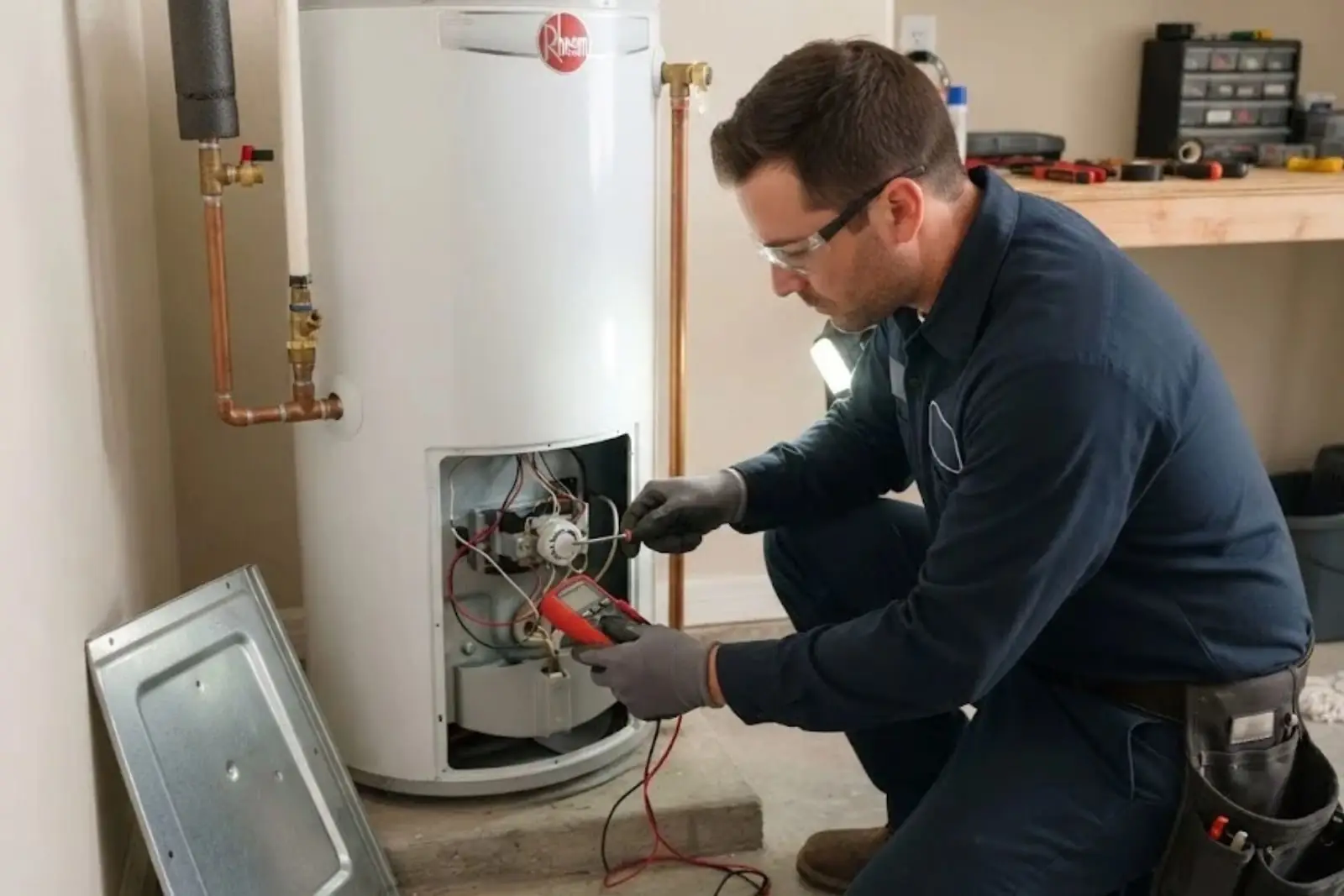
Replacing a thermocouple on a gas water heater is one of the smaller repairs a plumber does. Published national cost guides from 2025 and 2026 put a professional thermocouple replacement at about $150, with the part itself near $20. For a home in Marina, CA, treat those figures as a starting point and not as a quote.
The part matters because it is a safety sensor. It detects the pilot flame and lets gas flow, and it shuts the gas off when the flame is gone. Below you will find the typical costs, the signs that point to this part, the steps for a gas smell, and how to decide between repair and a new heater.
What a thermocouple does and why it fails
A thermocouple is a small metal probe that sits in the pilot flame of a gas water heater. Heat from the flame produces a tiny electrical signal. That signal tells the gas control valve that the pilot is burning, so the valve keeps gas flowing to the burner.
When the probe wears out or gets coated with soot, the signal weakens. The control then treats the pilot as out and closes the gas, even when the flame looks fine. That is the safety design working as intended, and it is why a failing thermocouple shows up as a pilot that will not stay lit.
You may also see the word thermopile in parts listings. One major retailer describes a thermopile as several thermocouples wired in series. Check your heater's model label and manual before you order any part, because we do not describe how a thermopile works in water heaters here.
Common signs of a failing thermocouple
- The pilot lights while you hold the knob down, then goes out when you let go.
- The pilot goes out again after a day or two, and you have no hot water until you relight it.
- The flame looks small, yellow or lazy instead of steady and blue.
- The pilot stays lit but the burner never fires, which can also point to the gas control valve.
Typical thermocouple and related repair costs
Most published guides give national figures only. We found no Central Coast or Monterey County price for this repair, so the table shows what national guides printed in 2025 and 2026. A Marina price depends on the heater, access and the work found when the cover comes off.
| Item | Typical published range | Source type and year |
|---|---|---|
| Thermocouple replacement by a plumber | About $150, often under an hour, part near $20 | National cost guides, 2025 and 2026 |
| Thermocouple part only | $5 to $20 | Do-it-yourself parts figure, 2026. Not a plumber price |
| Pilot light relight service call | $50 to $150 | National cost guides, 2025 and 2026 |
| Anode rod replacement | $50 to $150 including labor | National cost guide, 2025 |
| Gas water heater repair, general | $150 to $500 | National cost guide, 2025 |
| All water heater repairs | $222 to $990, national average $606 | National cost guide, 2025 |
| Water heater replacement | $850 to $1,800 | National cost guide, 2026 |
The thermocouple is cheap and the labor is short, so a plumber visit often costs several times the part. You are paying for safe gas-side work, testing the connections and confirming the burner lights and stays lit.
Worth knowing
A low part price does not mean the visit will cost the part price. Ask what the visit covers before work starts. We give a clear price before work starts, so you can say yes or no.
If you smell gas, leave first
A water heater pilot problem is an inconvenience. A gas smell is an emergency. Natural gas has an added rotten-egg odor, and other signs include a hissing or whistling sound near a line or appliance.
What PG&E says to do
Leave the area now and call 911 from a safe distance. Then call PG&E at 1-800-743-5000. Do not light matches, flip switches or use a flashlight inside the house while the smell is present.
Do not rely only on your nose, since some people cannot smell the additive well. If you shut the gas off at the meter, PG&E says you must call them to restore it.
- Do not call 811 for a gas smell. That number is for locating buried lines before digging.
- Do not try to relight a pilot in a room that smells like gas.
- We cannot promise a gas response time, so the utility and 911 come first.
Once the area is safe and the utility has cleared it, a plumber can inspect the heater's gas connections and controls.
Pilot will not stay lit even with a new part
If the pilot still drops out after a new thermocouple, the cause is somewhere else. A home guide for water heaters tells readers to call a professional in that situation, and so do we.
- The flame is not touching the tip of the probe, because the probe is bent or loose.
- The gas control valve is faulty and is not holding the pilot circuit open.
- The pilot tube or orifice is partly blocked by dust or soot.
- A draft or venting problem is blowing the flame around.
A venting problem deserves extra care. Exhaust from a gas heater contains carbon monoxide, which you cannot see or smell. PG&E lists poorly vented water heaters and blocked vents as sources, and it recommends a UL-approved CO detector.
After any gas-side repair, the connections should be tested with soapy water. If bubbles form, shut off the gas and call a professional. Leaving that to chance is not a good trade for saving an hour of labor.
Repair the heater or replace it
Conventional tank heaters last about 8 to 12 years in most guides, and some say 10 to 15. A new thermocouple on a young heater is easy math. On an old tank with rust at the base, a leak, or loud popping, the same $150 is money toward a heater that may fail soon.
| Situation | Usually points to |
|---|---|
| Heater under about 8 years old, only the pilot misbehaves | Replace the thermocouple |
| Heater 10 years or older, first repair needed | Repair if the tank is dry and sound, and plan for a replacement |
| Water at the base of the tank or rust streaks | Replacement, since a leaking tank cannot be repaired |
| Pilot problem returns after a new thermocouple | Have the gas control valve and venting checked |
| Repair quote near half the cost of a new unit | Compare against a replacement quote |
If replacement wins, see our pages on water heater replacement and tankless water heaters. If you want the unit looked at first, water heater repair is the place to start.
What changes the price of the visit
Three things move the price more than the part does. The first is the fuel and which component failed. A gas heater needs gas-side testing, and a failed control valve costs far more than a thermocouple.
The second is the age of the unit, because an old heater raises the question of repair versus replacement. The third is access. A heater in a tight closet, a garage corner or an attic takes longer to reach, and national guides show attic installs adding several hundred dollars to full replacements.
Marina water and local rules that affect this repair
Marina Coast Water District pumps groundwater from wells in the Salinas Valley basin. Its 2025 water quality report gave total hardness at 180.3 mg/L on average, or 10.54 grains per gallon, with readings up to about 19 gpg. The district says there is no drinking water standard for hardness, but it recommends flushing the water heater regularly. For you, that means sediment can collect in the tank, and a gas burner has to work through that scale.
Ask your plumber to check the anode rod and drain a few gallons while they are at the heater. That is cheap work when the cover is already off.
California law requires new and replacement water heaters, and existing residential ones, to be braced, anchored or strapped against earthquake motion. If a repair visit shows loose or missing straps, fix that at the same time. If you are replacing instead of repairing, ask the City of Marina Building Division at (831) 884-1241 about permits, since we could not confirm the city's rule on its public pages.
We take calls from Marina and the nearby areas. See our pages for Seaside and Castroville if that is where you live.
Frequently asked questions
The part is cheap and some owners do it. It is still gas-side work, and a mistake can leave a leak at a fitting. If you are not sure how to shut off the gas and test connections, hire a licensed plumber.
National guides describe it as under an hour for a plumber on an accessible heater. Rusted fittings, tight spaces or a second problem can add time.
The thermocouple may not be sensing the flame, so the control closes the gas. It can also be a faulty gas control valve or a blocked pilot tube. A plumber can test which one it is.
Usually it means no hot water, which is urgent but not dangerous. A gas smell is different. If you smell gas, leave, call 911, then call PG&E at 1-800-743-5000.
No. The thermocouple is the sensor and the gas control valve is the unit that opens and closes the gas. A bad valve is a larger repair.
Use the License Check tool on the Contractors State License Board website, or call 1-800-321-CSLB. Plumbing work is classified C-36. Unlicensed work is limited to jobs under $1,000 in total that need no permit.
Marina Coast Water District recommends regular flushing following the manufacturer's guidance, because hardness leaves mineral buildup. The district's 2025 report listed an annual average near 10.5 grains per gallon. Flushing helps the burner heat water through less scale.